
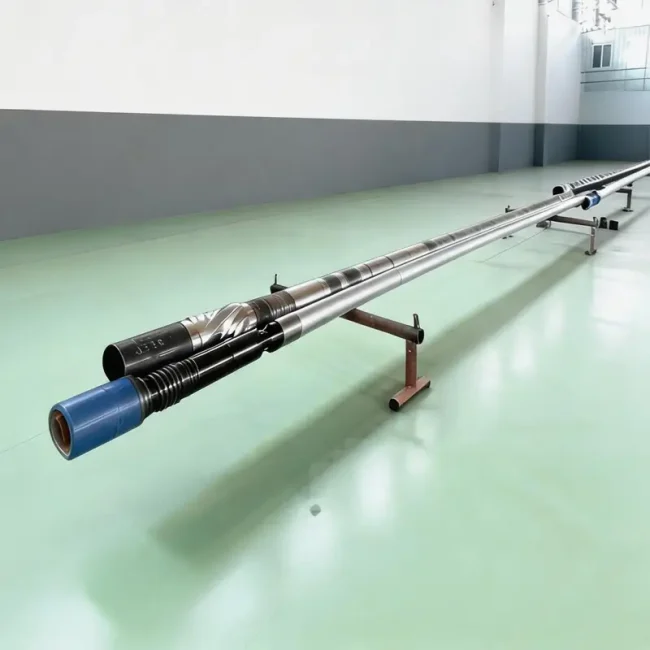
Coring is a critical operation in drilling activities where continuous, intact rock or formation samples (cores) are retrieved from subsurface layers. Unlike conventional drilling, which primarily focuses on penetration and hole creation, coring is designed to preserve the geological structure, lithology, and fluid content of the formation.
At KTK Energy Limited, coring applications are supported through advanced core drill bits (coring bits), core barrels, and integrated BHA systems, enabling high core recovery and reliable data acquisition across a wide range of drilling environments.
Coring plays a fundamental role in exploration, reservoir evaluation, geotechnical analysis, and mining operations, providing the data required for informed engineering and economic decisions.
Why Coring is Essential in Drilling Operations
Coring is not simply a sampling process—it is a data acquisition strategy that directly impacts reservoir development, well placement, and production optimization.
Key Objectives of Coring
- Obtain undisturbed formation samples
- Determine porosity, permeability, and saturation
- Identify lithology and mineral composition
- Evaluate fractures, faults, and structural features
- Support petrophysical and geomechanical analysis
Without coring, operators must rely solely on indirect measurements such as logging data, which may not provide the same level of accuracy.
Types of Coring Applications
1. Conventional Coring (Full Diameter Coring)
Conventional coring involves cutting a full-diameter core using a coring bit and retrieving it via a core barrel assembly. This method is widely used in oil and gas exploration wells where high-quality samples are required.
Key Characteristics:
- Large core diameter
- High sample integrity
- Suitable for detailed laboratory analysis
Applications:
- Reservoir characterization
- Formation evaluation
- Stratigraphic studies
2. Wireline Coring
Wireline coring allows the inner core barrel to be retrieved without pulling out the entire drill string, significantly improving operational efficiency.
Advantages:
- Reduced trip time
- Increased drilling efficiency
- Lower operational cost
Typical Use Cases:
- Deep exploration wells
- Offshore drilling operations
- Continuous coring programs
3. Sidewall Coring
Sidewall coring is performed after drilling using specialized tools to extract small core samples from the wellbore wall.
Types:
- Mechanical sidewall coring
- Rotary sidewall coring
Applications:
- Supplementary sampling
- Targeted zone evaluation
- Logging data calibration
4. Pressure Coring
Pressure coring preserves formation pressure and fluid content, making it essential for studying hydrocarbons in their native state.
Key Benefits:
- Maintains reservoir conditions
- Enables accurate fluid analysis
- Critical for unconventional reservoirs
Applications:
- Shale gas and tight oil reservoirs
- Gas hydrate studies
- Advanced reservoir engineering
Coring Applications in Oil & Gas Industry
Exploration Drilling
Coring is extensively used in exploration wells to confirm the presence of hydrocarbons and understand reservoir characteristics.
Key Data Obtained:
- Rock type and depositional environment
- Hydrocarbon saturation
- Reservoir quality indicators
Reservoir Characterization
Core samples provide direct measurements that cannot be obtained through logging alone.
Core Analysis Includes:
- Porosity and permeability testing
- Capillary pressure analysis
- Relative permeability studies
These data sets are essential for reservoir modeling and simulation.
Development and Production Optimization
During field development, coring helps refine reservoir models and optimize production strategies.
Use Cases:
- Well placement optimization
- Completion design
- Enhanced oil recovery (EOR) planning
Unconventional Resources
In shale and tight formations, coring is critical for evaluating rock mechanics and fracture behavior.
Applications:
- Hydraulic fracturing design
- Brittleness and stress analysis
- Organic content evaluation
Coring Applications in Mining Industry
Coring is widely used in mineral exploration to determine ore grade, structure, and economic viability.
Key Functions
- Identify mineral composition
- Estimate ore reserves
- Analyze structural geology
Typical Materials
- Gold, copper, iron ore
- Rare earth elements
- Industrial minerals
Coring Applications in Geotechnical Engineering
In geotechnical drilling, coring provides essential data for construction and infrastructure projects.
Applications
- Foundation design
- Tunnel construction
- Dam and bridge engineering
Key Parameters Measured
- Rock strength
- Soil stability
- Fracture distribution
Coring in Directional and Horizontal Drilling
Modern drilling operations increasingly involve directional and horizontal wells, where coring presents additional challenges.
Coring tools must be compatible with:
- MWD system
- LWD system
- BHA
Challenges
- Maintaining toolface orientation
- Ensuring core integrity in deviated wells
- Managing torque and drag
Solutions
KTK Energy provides engineered coring solutions designed for integration with directional drilling systems, ensuring stable performance and accurate sampling.
Key Equipment Used in Coring Applications
A complete coring system includes:
- Core Drill Bit (Coring Bit)– Cuts and forms the core
- Core Barrel Assembly– Houses and retrieves the core
- Drill String & BHA– Provides mechanical force and stability
- Fluid System– Removes cuttings and cools the bit
Each component must be optimized to ensure maximum core recovery and operational efficiency.
Operational Considerations in Coring
1. Formation Type
Different formations require different bit designs:
- Soft formations → PDC core bits
- Hard formations → Diamond core bits
2. Drilling Parameters
- Weight on bit (WOB)
- Rotary speed (RPM)
- Flow rate
Proper optimization improves core quality and bit life.
3. Core Handling and Preservation
Core samples must be carefully handled to avoid:
- Mechanical damage
- Fluid contamination
- Loss of formation pressure
Advantages of Advanced Coring Solutions
KTK Energy coring solutions offer:
- High core recovery ratesfor accurate analysis
- Reduced operational timethrough optimized design
- Compatibility with complex BHA systems
- Adaptability across global drilling environments
- Cost-effective supply through China-based manufacturing integration
Future Trends in Coring Technology
The industry is evolving toward:
- Digital core analysis integration
- Real-time coring data acquisition
- Advanced materials for longer bit life
- Automation and remote operation
These innovations are improving both efficiency and data accuracy in drilling operations.
Conclusion
Coring applications are a cornerstone of modern drilling operations, enabling operators to obtain high-quality subsurface data that drives exploration success and production efficiency.
From oil and gas reservoirs to mining and geotechnical projects, coring provides direct insight into formation properties, making it indispensable for engineering decision-making.
With its engineering-driven approach and integrated supply chain capabilities, KTK Energy Limited delivers reliable, API-compliant coring solutions tailored to the needs of global drilling contractors and oilfield service companies.