
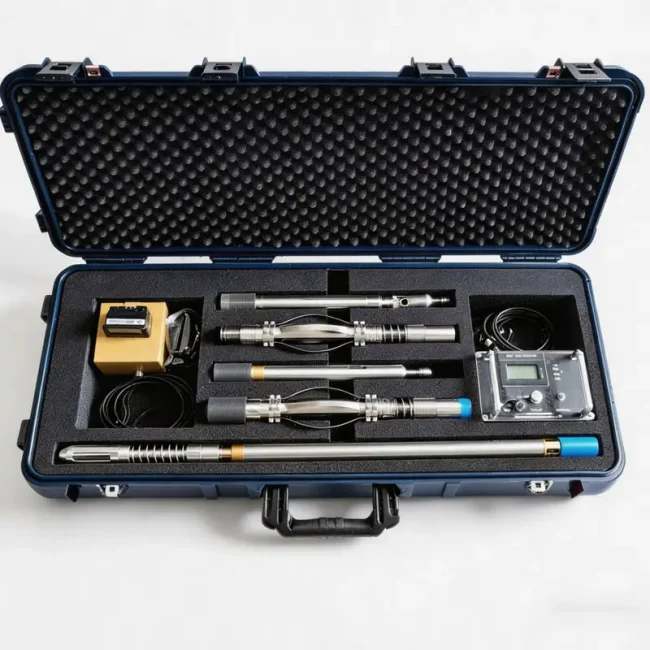
A gyro survey tool is a downhole instrument used in directional drilling operations to determine wellbore position, including inclination, azimuth, and toolface orientation, without relying on magnetic references.
Unlike conventional magnetic systems, north-seeking gyro tools measure the Earth’s rotation and gravity field to calculate true north, making them suitable for environments where magnetic interference is present.
Product Introduction
The KTK Gyro Survey Tool is a north-seeking, continuous survey system designed for high-accuracy wellbore positioning in challenging drilling environments.
It utilizes solid-state inertial sensors combined with advanced navigation algorithms to deliver
stable and repeatable survey results under high shock, vibration, and temperature conditions.
The system supports multiple operating modes, including continuous survey and memory mode, enabling flexibility for different drilling and survey applications.
Key Features
- Solid-state inertial sensors
- No field calibration required
- High reliability in harsh downhole environments
- True north-seeking capability
- Independent of magnetic interference
- Suitable for cased holes and complex formations
- Continuous survey mode
- High-speed data acquisition up to 150 m/min
- Improves operational efficiency
- Dual-system navigation architecture
- Stable platform + strapdown inertial system
- Enhanced accuracy through advanced filtering algorithms
- Compact and lightweight design
- Suitable for slim-hole applications
- Optimized for easy deployment
Technical Specifications
| Parameter | Specification |
| Inclination Accuracy | ±0.1° |
| Azimuth Accuracy | ±1.0° |
| North-Seeking Time | 30 seconds |
| Operating Modes | GyroCompass, Continuous, Memory, Drop |
| Survey Speed | Up to 150 m/min |
| Temperature Rating | 80°C / 110°C / 125°C (up to 200°C with heat shield) |
| Pressure Rating | 80 MPa |
| Outer Diameter | 35 mm (standard), 45 mm (with heat shield) |
| Length | 1982 mm |
| Weight | 10 kg |
Applications
This gyro survey tool is widely used in:
- Directional drilling operations
- Cased hole surveying
- Anti-collision well planning
- Re-entry and sidetrack wells
- Urban drilling and magnetic interference environments
Advantages in Directional Drilling Systems
In modern directional drilling tools systems, gyro survey tools are commonly used together with:
- MWD tools(for real-time data transmission)
- PDM motors(for directional control)
- BHA components(for structural stability)
Why use a gyro instead of MWD?
- Gyro tools provide true north reference
- MWD tools rely on magnetic measurements
This makes gyro tools essential in:
- High-interference environments
- Steel casing or nearby wells
Use Case Example
In complex drilling environments such as urban or offshore fields, where magnetic interference affects MWD systems, gyro survey tools provide reliable wellbore positioning data to ensure accurate trajectory control.
FAQ
What is a gyro survey tool used for in oil and gas?
A gyro survey tool is used to determine wellbore inclination and azimuth based on true north, especially in environments where magnetic interference affects conventional MWD tools.
How does a gyro survey tool differ from MWD tools?
Gyro tools use Earth rotation and gravity measurements, while MWD tools rely on magnetic sensors. Gyro systems provide higher accuracy in non-magnetic environments.
When should a gyro survey tool be used?
It is recommended in cased holes, urban drilling, or areas with high magnetic interference where MWD accuracy may be affected.
What is the advantage of continuous gyro surveying?
Continuous mode allows high-speed data acquisition during tool movement, improving operational efficiency and reducing survey time.
Can gyro tools operate in high-temperature wells?
Yes, this tool supports temperatures up to 125°C, and up to 200°C with a heat shield, making it suitable for high-temperature drilling environments.